

Africa stands at a critical turning point in its public health journey. In the aftermath of the COVID-19 pandemic, the continent has embraced a bold new vision that seeks to transform vulnerability into resilience and dependency into ownership. This vision, known as Africa’s Health Security and Sovereignty (AHSS) agenda, is not simply a policy framework—it is a declaration of independence in health, a roadmap for sustainable development, and a commitment to global health security.
As the Africa Centres for Disease Control and Prevention (Africa CDC) explains, “achieving universal health coverage, pandemic preparedness, and sustainable development cannot be realised without health sovereignty—the ability of African nations to finance, produce, and govern their own health systems and countermeasures”. The AHSS agenda emerges from the lessons of the COVID-19 pandemic, which exposed deep inequalities in the global health system.
Africa faced severe inequities in access to vaccines, medicines, and diagnostics, leaving millions vulnerable. As the report notes, “Africa must move from only being a beneficiary to becoming an equal co-architect of the global health system, because the continent’s 1.5 billion citizens cannot depend on external supply chains or emergency goodwill when the next pandemic strikes”. This statement captures the urgency of Africa’s transformation: sovereignty in health is not optional, it is essential for survival and progress.
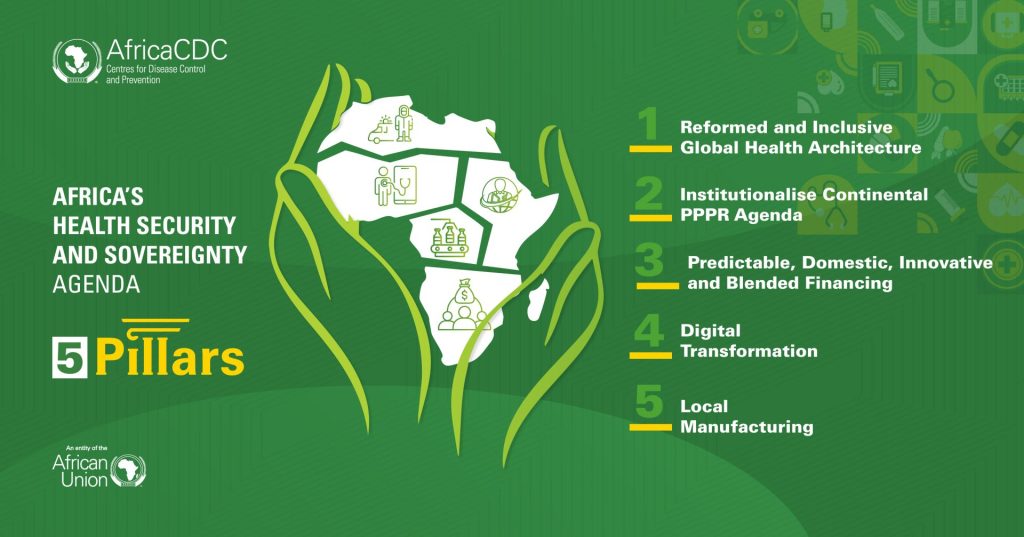
At the heart of this agenda are five interconnected pillars that together form the foundation of Africa’s health sovereignty. The first pillar calls for a reformed and inclusive global health architecture. This means moving beyond the outdated donor–recipient model and empowering African institutions to lead.
Africa CDC emphasizes that “regional mechanisms, such as Africa CDC’s Regional Integrated Surveillance and Laboratory Networks (RISLNET), show how proximity, political legitimacy, and contextual understanding enable faster, more coordinated responses to public health threats”. By strengthening regional networks, Africa can respond more effectively to outbreaks like mpox, cholera, and Marburg virus disease, which have surged across the continent in recent years.
“ The goal is simple but transformative—to expand community-based health-insurance schemes so we can drastically reduce out-of-pocket spending, and to ensure that at least 50% of Africa’s health-security financing is generated from national budgets ”
Africa CDC
The second pillar focuses on institutionalizing continental preparedness, prevention, and response. Africa CDC has established the Incident Management Support Team (IMST) and the Africa Epidemics Fund (AfEF) to unify emergency systems and ensure rapid financing. This shift represents a deliberate move from ad-hoc emergency responses to permanent, continent-wide readiness. As the report highlights, “Together, these mechanisms aim to ensure that Africa can prevent,
detect, and respond to outbreaks with appropriate resources, teams, and stockpiles of medical countermeasures”. The third pillar addresses financing, a cornerstone of sovereignty. Africa’s health systems have long been weakened by overreliance on external aid and catastrophic out-of-pocket spending.
The AHSS agenda seeks to secure predictable, domestic, innovative, and blended financing. The Lusaka Agenda, endorsed by the African Union, embodies this approach by institutionalizing domestic health spending and leveraging instruments such as solidarity levies, diaspora bonds, and health taxes.
Digital transformation forms the fourth pillar, positioning technology as the backbone of resilient primary health care. Africa CDC is building a PHC Digital Intelligence Ecosystem that links community health workers, facilities, districts, and national health intelligence centres through real-time data systems.
Initiatives such as the Digital Birth-to-Care Card and the African Health Data Governance Framework will ensure that no child, woman, or community is left invisible. As the report explains, “Digitalisation is not only a tool for efficiency, it is also the infrastructure for sovereignty in the data age”. By owning and managing its health data, Africa can safeguard its future and avoid dependency on external partners.
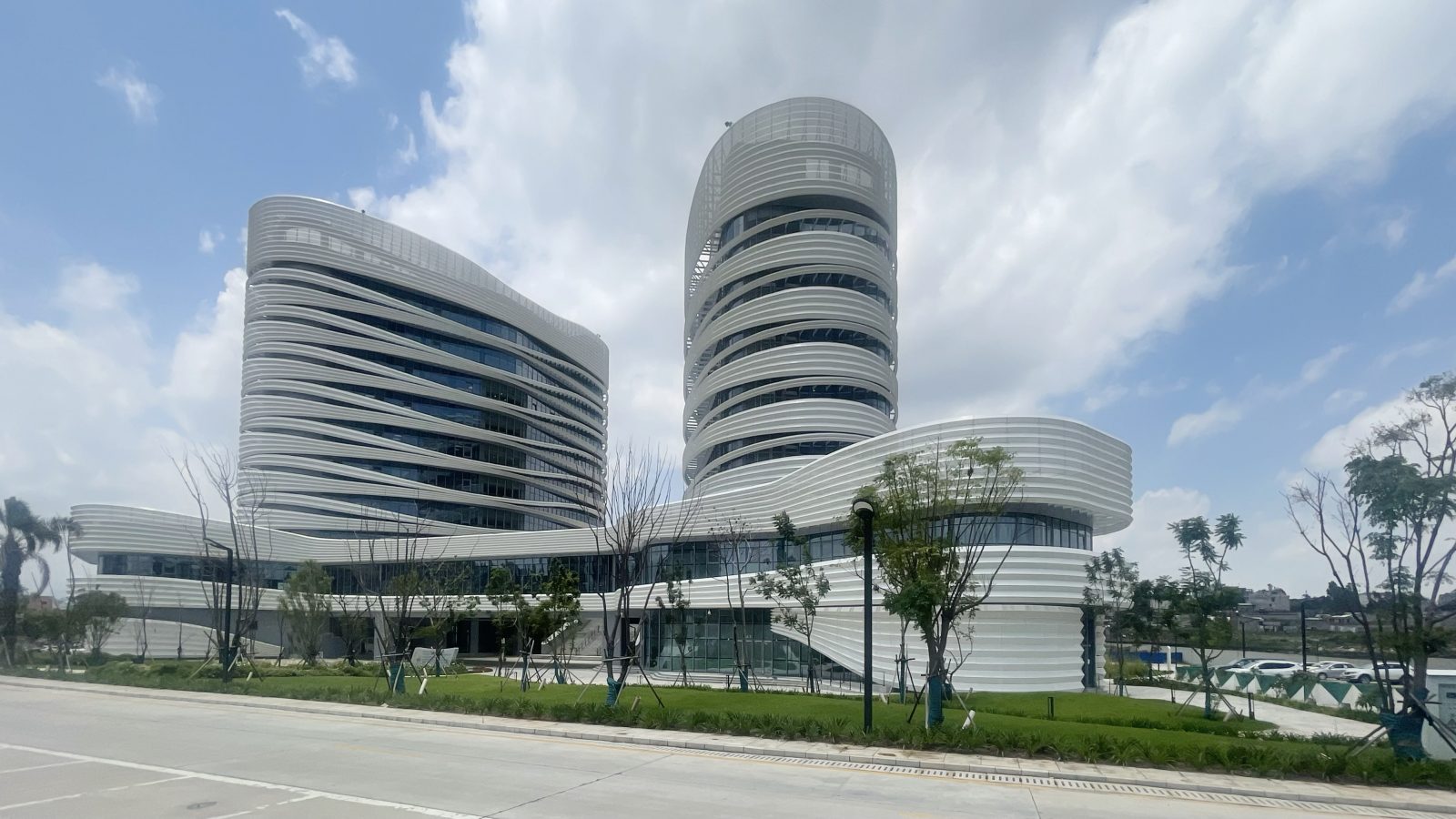
The fifth pillar emphasizes local manufacturing as the engine of Africa’s second independence. Currently, the continent imports more than 90% of its health commodities, leaving it vulnerable to supply chain disruptions. The AHSS agenda aims to guarantee that at least 60% of vaccines, diagnostics, and therapeutics used on the continent are produced locally by 2040.
Africa CDC notes that “Supporting the Platform for Harmonized African Health Manufacturing… Africa CDC aims to guarantee that at least 60% of vaccines, diagnostics, and therapeutics used on the continent are produced locally by 2040”. This commitment is not only about health security—it is about economic empowerment, job creation, and sustainable development.
Of course, the path to sovereignty is not without challenges. Persistent financing gaps, limited local manufacturing capacity, governance vulnerabilities such as procurement fraud, workforce shortages, and uneven adoption of digital health systems all threaten progress.
Yet Africa CDC has introduced key tools to overcome these barriers, including accountability frameworks, digital transformation agendas, and partnerships with organizations like Starlink to ensure connectivity of health systems. The report emphasizes that “Africa’s vision of health security and sovereignty is not isolationist, but a vision of shared responsibility and leadership”.
This vision represents Africa’s transition from dependency to ownership, from vulnerability to resilience, and from aspiration to action. It is a call to the world to recognize Africa not as a passive recipient of aid, but as a leader in shaping global health security. As Dr. Jean Kaseya, Director of Africa CDC, concludes, “A sovereign and secure Africa strengthens global health security for all”.
The AHSS agenda is more than a policy—it is a movement. It is Africa’s declaration that health sovereignty is the foundation of freedom, dignity, and progress. By embracing this vision, Africa is not only protecting its own citizens but also contributing to a safer, healthier, and more equitable world.
Source: Africa’s Health Security and Sovereignty agenda: a new way forward