

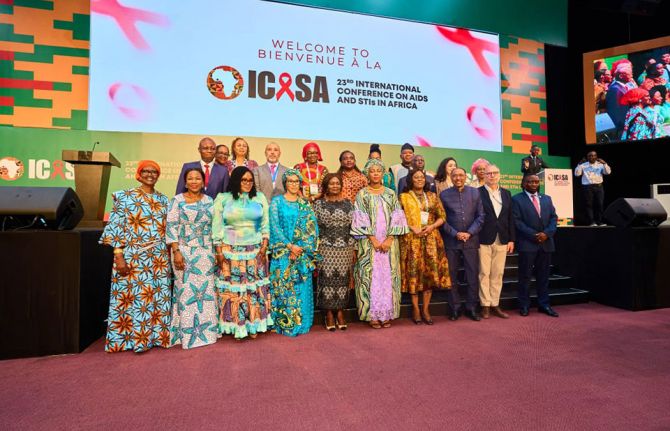
The global fight against HIV is at a critical turning point, and nowhere is this more evident than in Africa. At the 23rd International Conference on AIDS and STIs in Africa (ICASA), held in Accra, Ghana from December 3–8, 2025, UNAIDS issued a powerful call to action for governments, donors, and communities to safeguard the progress made over the past two decades. The conference brought together leaders, policymakers, and advocates to confront the growing challenges posed by funding cuts and to chart a path toward ending AIDS by 2030.
UNAIDS Executive Director Winnie Byanyima and Deputy Executive Director Angeli Achrekar joined regional representatives to emphasize the urgency of renewed political commitment and domestic investment. The HIV response, they warned, is facing one of its biggest disruptions in decades. International donor funding has declined sharply, leaving many African countries struggling to maintain lifesaving prevention and treatment programs.
UNAIDS stressed that these cuts threaten to reverse hard-won gains, including expanded access to antiretroviral therapy and prevention services across sub-Saharan Africa. As the organization stated, “The HIV response is facing one of the biggest disruptions following funding cuts from international donors which has had severe consequences for African countries most affected by HIV.”
The consequences of reduced funding are stark. Millions of people living with HIV depend on consistent access to treatment, and interruptions can lead to drug resistance, increased transmission, and preventable deaths. UNAIDS highlighted that the progress achieved since the early 2000s—when HIV was one of the deadliest epidemics in Africa—could be undone if solidarity and investment waver. The organization’s vision of “zero new HIV infections, zero discrimination, and zero AIDS-related deaths” remains achievable, but only if governments and donors recommit to the fight.
One of the most promising developments discussed at ICASA was the arrival of new long-acting HIV prevention innovations. These technologies, including injectable PrEP and other sustained-release options, have the potential to revolutionize prevention efforts by reducing the burden of daily pill regimens and improving adherence. UNAIDS emphasized that these innovations could stop new infections and transform the landscape of HIV prevention.
However, without adequate funding and equitable distribution, their impact will be limited. As UNAIDS noted, “With new, long-acting HIV prevention innovations coming to market which could revolutionize HIV prevention efforts and stop new HIV infections, UNAIDS is calling for solidarity, commitment and concerted efforts by donors, governments and communities to end AIDS by 2030.”
The conference also highlighted the importance of domestic investment. While international support has been vital, African countries must strengthen their own health systems and allocate resources to sustain HIV programs. This includes integrating HIV services into broader health initiatives, expanding community-based care, and ensuring that marginalized populations are not left behind. Political will is essential, and leaders were urged to prioritize HIV in national agendas.
UNAIDS reminded participants that the fight against HIV is not only a medical challenge but also a social and human rights issue. Discrimination and stigma continue to hinder access to care, particularly for vulnerable groups such as women, young people, and key populations. Ending AIDS requires addressing these barriers and ensuring that everyone can access prevention, treatment, and support without fear of judgment or exclusion.


The ICASA conference in Accra served as a rallying point for solidarity. By bringing together stakeholders from across Africa and beyond, it reinforced the idea that ending AIDS is a shared responsibility. Governments must commit resources, donors must sustain support, and communities must remain engaged. The message was clear: the world cannot afford complacency.
In conclusion, UNAIDS’ call at ICASA 2025 is both a warning and an opportunity. The warning is that funding cuts and wavering commitment could undo decades of progress. The opportunity is that with renewed solidarity, investment, and innovation, the world can still achieve the goal of ending AIDS by 2030. As Winnie Byanyima and her colleagues made clear, the fight is far from over, but the tools, knowledge, and determination exist to win. The future of the HIV response depends on whether governments, donors, and communities rise to the challenge.