

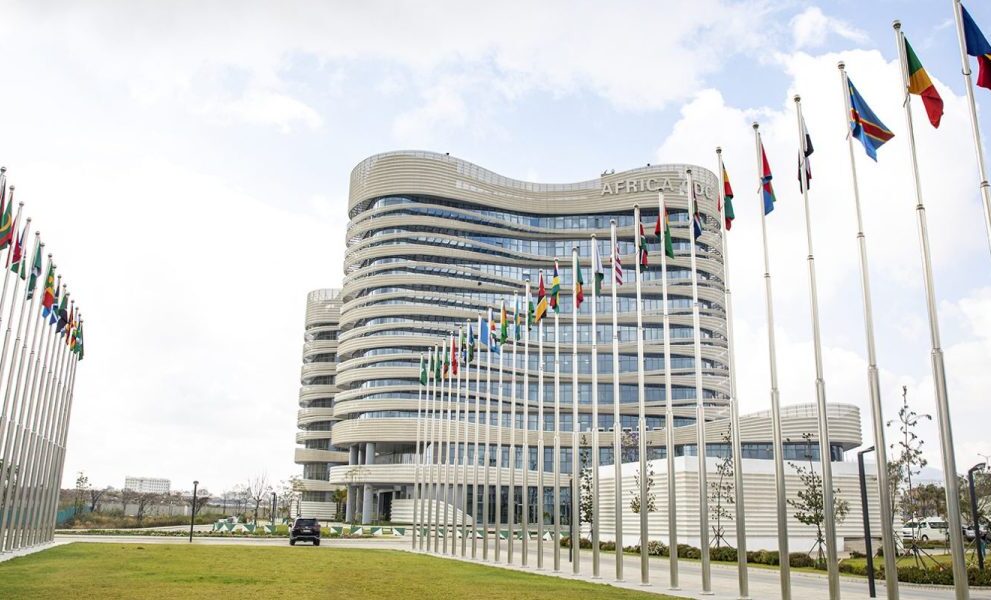

Strengthening Africa’s health security demands partnerships built on mutual accountability and results.
Dr Jean Kaseya
Africa is taking a decisive step toward stronger, self-reliant public health systems with a strategic partnership that promises to reshape how the continent prevents, detects, and responds to disease threats. The Memorandum of Understanding
between the Africa Centres for Disease Control and Prevention (Africa CDC) and FHI 360 establishes a high-impact framework for collaboration focused on health security, workforce development, laboratory strengthening, surveillance modernization, and sustainable national ownership of health systems. This agreement aligns with the Africa CDC Strategic Plan (2023–2027) and the Africa Health Security and Sovereignty Agenda, signaling a coordinated push for resilient, locally led public health capacity across all regions of the continent.
The partnership targets the core pillars that drive effective epidemic prevention and response. By combining Africa CDC’s continental mandate with FHI 360’s decades of technical experience in infectious disease control, data platforms, and workforce training, the MoU aims to deliver measurable improvements in surveillance systems, epidemic intelligence, laboratory networks, and emergency preparedness. These are the building blocks of a health security architecture that reduces reliance on external actors and strengthens national and regional capacities to manage outbreaks and health emergencies.
This collaboration emphasizes digital transformation and integrated data systems as essential enablers of modern public health. Investments in interoperable data platforms and performance-linked financing models will help governments track disease trends in real time, allocate resources more efficiently, and hold systems accountable for outcomes. The MoU also highlights the importance of institutional capacity-building and private sector engagement to accelerate innovation and domestic manufacturing of health products—critical steps toward continental self-reliance and economic resilience in health.
A central objective of the agreement is to strengthen the health workforce across African Union Member States. The plan includes targeted programs for training, deploying, and retaining skilled public health professionals and community health workers. Strengthening human resources for health is not only a technical priority but a strategic investment in long-term sustainability: well-trained personnel are essential to maintain surveillance systems, operate laboratory networks, and lead emergency responses at national and subnational levels. FHI 360’s global footprint and experience in workforce development will complement Africa CDC’s regional coordination role to scale up capacity-building initiatives.
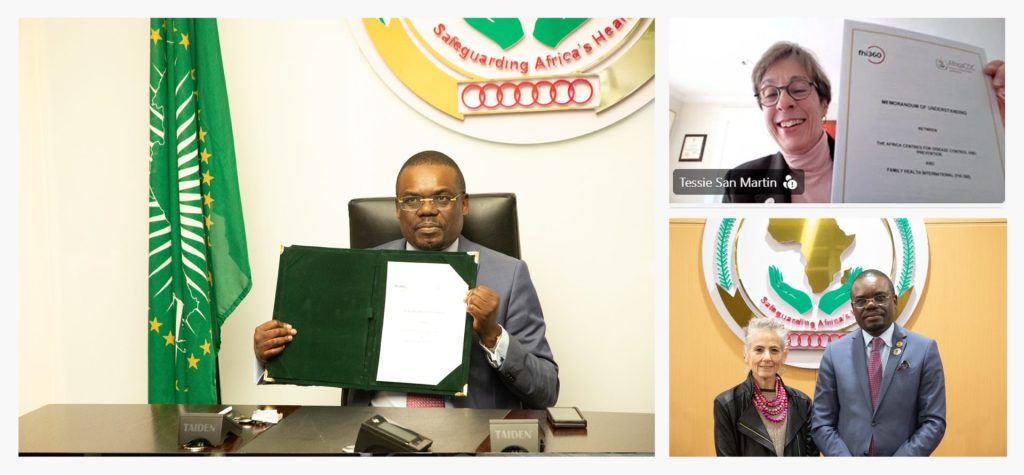
The MoU also commits both organizations to align with evolving global health security frameworks while prioritizing country-led, government-to-government engagement. This approach reinforces national ownership and ensures that interventions are tailored to local contexts and priorities. By formalizing cooperation on integrated data systems and performance-linked financing, the partnership seeks to create sustainable mechanisms that incentivize results and strengthen accountability across health programs. These measures are designed to make preparedness investments more effective and to ensure that gains are maintained beyond short-term project cycles.
Economic resilience and local manufacturing capacity are woven into the partnership’s vision for health sovereignty. Building domestic production capabilities for essential health commodities reduces supply chain vulnerabilities and supports faster, more reliable responses during crises. The MoU’s emphasis on manufacturing, financing, and private sector collaboration reflects a holistic strategy: health security is not only a medical challenge but also an economic and industrial priority that requires cross-sector coordination and long-term investment.
The public messaging around this agreement underscores a shared commitment to sustainable, locally driven solutions. Dr. Tessie San Martin, CEO of FHI 360, framed the partnership as a continuation of decades-long collaboration with African governments and civil society.

For more than five decades, FHI 360 has worked shoulder to shoulder with governments and civil society in countries across Africa to respond to health threats and promote strong and resilient health systems.
Dr. Tessie San Martin
This statement captures the partnership’s ethos—long-term engagement, technical depth, and a focus on national ownership.
For policymakers, donors, and health leaders, the MoU offers a clear roadmap for action: prioritize investments in surveillance and laboratory networks, scale workforce development programs, adopt integrated digital health platforms, and design financing models that reward performance and sustainability. For civil society and community health actors, the partnership signals increased support for community-level interventions and the scaling of community health worker programs—critical for early detection and response in remote and underserved areas. For the private sector, the agreement opens pathways for public-private partnerships that can accelerate manufacturing, logistics, and technology adoption.
This initiative arrives at a pivotal moment. Recent global health crises have exposed gaps in preparedness and the consequences of fragmented systems. Africa’s path to health sovereignty depends on coordinated continental strategies that are backed by technical expertise, sustainable financing, and political commitment. The Africa CDC–FHI 360 MoU is a strategic response that combines institutional leadership with operational know-how to close those gaps and build resilient systems that protect lives and livelihoods.
To maximize impact, the partnership will need transparent monitoring and evaluation frameworks that track progress against clear indicators—such as improvements in laboratory turnaround times, expansion of surveillance coverage, numbers of trained health workers deployed, and the scale-up of domestic manufacturing capacity. Performance-linked financing and government-to-government engagement are mechanisms that can help ensure that investments translate into measurable outcomes and sustained national ownership.
This agreement is more than a formal document; it is a strategic signal to the international community that Africa is investing in its own future. By centering local leadership, data-driven interventions, and sustainable financing, the MoU sets a course toward a continent that can prevent, detect, and respond to health threats with speed and autonomy. As Africa CDC and FHI 360 move from planning to implementation, the success of this partnership will be measured by stronger national systems, faster outbreak detection, and healthier, more resilient communities across Africa.