
Africa CDC and JIHS will strengthen scientific collaboration, reinforce public health institutions and workforce capacity, and accelerate our ability to prevent, detect, and respond to outbreaks
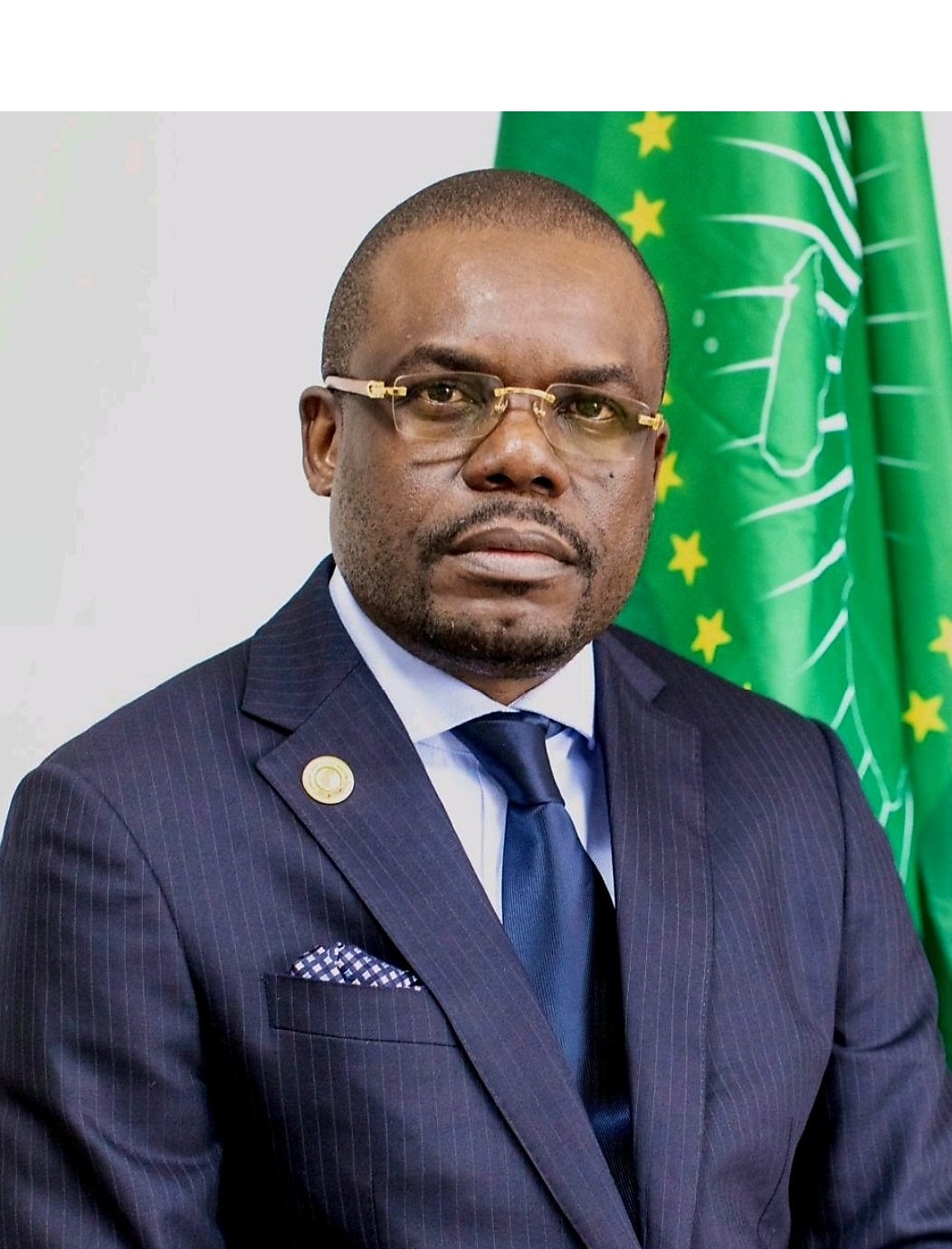
Dr Jean Kaseya
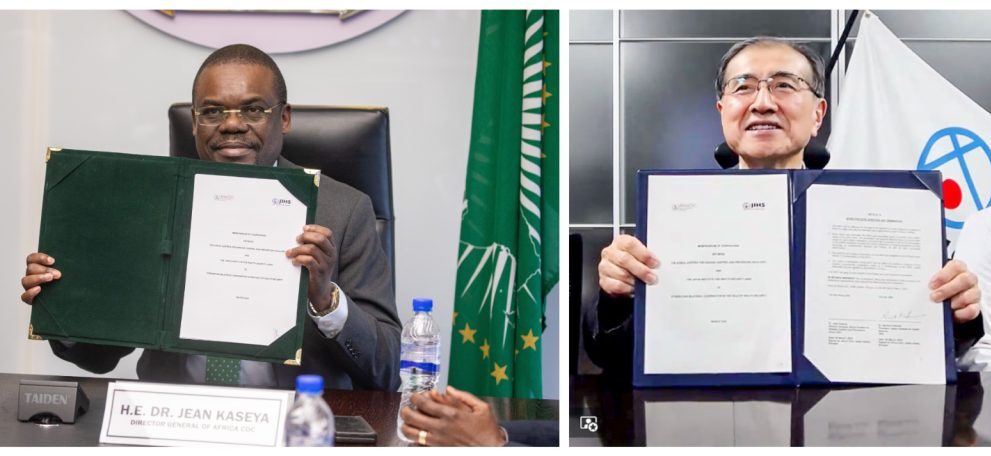
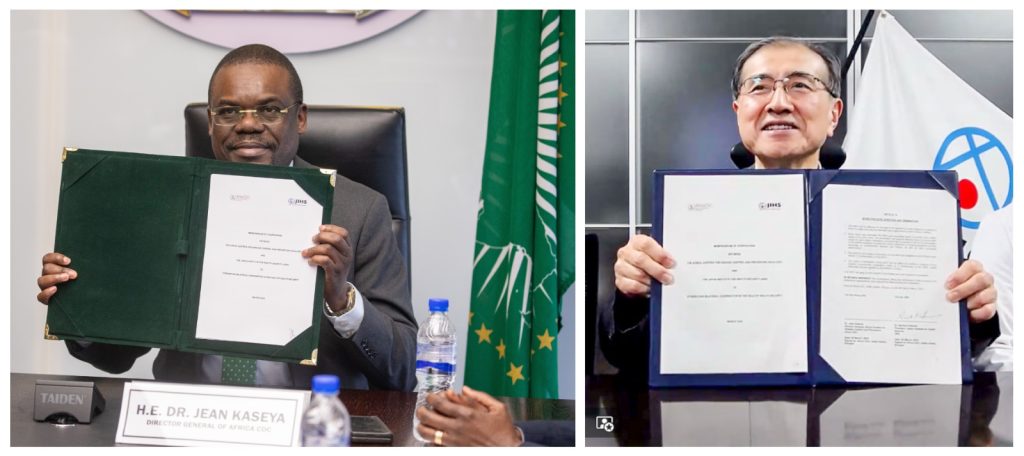
The Africa Centres for Disease Control and Prevention and the Japan Institute for Health Security have formalized a strategic partnership designed to elevate global health security, accelerate pandemic
preparedness, and strengthen infectious disease surveillance across Africa and beyond. This new Memorandum of Cooperation establishes a practical framework for joint action on early warning systems, laboratory and research capacity, workforce development, and One Health approaches that address zoonotic threats and antimicrobial resistance.
his emphasis on workforce development and institutional resilience is central to sustainable health security: training programs, institutional exchanges, and technical collaboration are prioritized to ensure that gains persist beyond short-term projects.
The agreement targets several high-impact domains that searchers and policymakers prioritize when evaluating health security investments. First, infectious disease surveillance and early warning systems will be strengthened through data-driven collaboration and shared intelligence. Second, laboratory and research capacity will be expanded to enable faster pathogen detection, genomic surveillance, and evidence-based interventions. Third, workforce development will be scaled through structured training and exchanges that build local expertise and leadership. Fourth, the partnership explicitly advances One Health and climate-resilient strategies to address zoonotic spillover, antimicrobial resistance, and other complex risks that cross human, animal, and environmental boundaries.
From a strategic perspective, this cooperation aligns with Africa CDC’s 2023–2027 Strategic Plan and the Africa Health Security and Sovereignty Agenda, reinforcing continental priorities for self-reliant, science-led preparedness. The partners will translate the Memorandum of Cooperation into a Joint Action Plan that defines priority activities, timelines, and implementation mechanisms—an essential step for turning high-level commitments into measurable outcomes. For stakeholders tracking funding, program milestones, and accountability, the Joint Action Plan will be the document to watch.
Why does this matters for global health? Simply because international partnerships that combine regional leadership with external technical expertise can accelerate the diffusion of best practices, laboratory standards, and rapid response protocols. Japan’s new national institute brings integrated infectious disease intelligence, clinical capabilities, and research capacity that complement Africa CDC’s continental mandate and regional networks. Together, they can close critical gaps in surveillance coverage, diagnostic turnaround times, and cross-border coordination—all of which reduce the time between detection and containment of outbreaks.
For public health professionals, funders, and policy advocates, the cooperation offers several practical opportunities: joint research projects that generate region-specific evidence; training fellowships that build a pipeline of epidemiologists, laboratorians, and emergency managers; pilot programs for integrated surveillance that combine human, animal, and environmental data; and technical assistance to strengthen national public health institutes. Each of these activities can be designed with measurable indicators—such as reduced detection-to-notification time, increased genomic sequencing capacity, or the number of trained professionals deployed during emergencies—to demonstrate impact and attract further investment.
Media and communications professionals will find the announcement notable for its emphasis on mutual learning and science-based preparedness. Professor Dr. Norihiro Kokudo of JIHS described the institute as “an integrated national institution combining infectious disease intelligence, research and development, clinical expertise, and international cooperation,” signaling Japan’s intent to share integrated capabilities and to support collaborative research and workforce development. This framing positions the partnership not as one-way aid but as a two-way exchange of knowledge and technical skills.
For communities and civil society, the agreement underscores the importance of inclusive preparedness that reaches beyond capital cities to strengthen district-level surveillance and response. Community engagement, risk communication, and local laboratory access are essential to ensure that early warnings translate into timely public health action. Civil society organizations can play a role in advocating for transparent reporting, equitable access to diagnostics and care, and community-centered training programs that build trust and resilience.
In summary, the Memorandum of Cooperation between Africa CDC and JIHS represents a strategic, actionable step toward stronger regional and global health security. By focusing on surveillance, laboratory capacity, workforce development, and One Health approaches, the partnership addresses the core components of resilient preparedness systems. The emphasis on a Joint Action Plan and measurable activities increases the likelihood that commitments will translate into sustained improvements in outbreak prevention, detection, and response. Stakeholders who monitor the Joint Action Plan, engage in collaborative research, and invest in durable capacity building will be best positioned to convert this high-level agreement into tangible public health gains.