
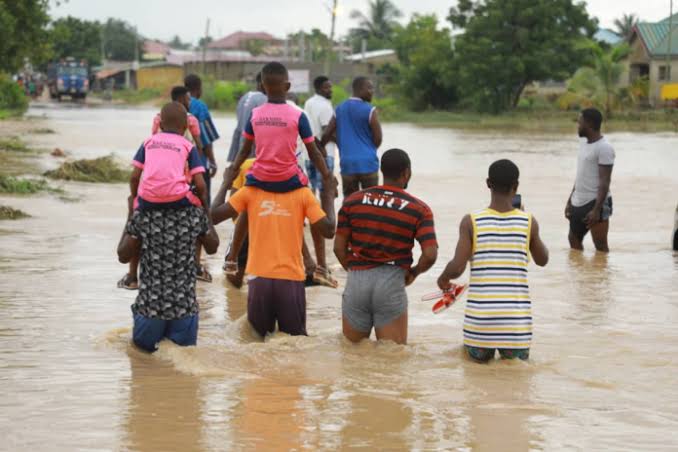
Accra woke up submerged again. Heavy rains that began late on Sunday, June 28, 2026 and rolled on into the morning of Monday, June 29 left major roads underwater and turned the city’s morning rush hour into a citywide emergency. The downpour left several major roads inundated with flood waters, forcing vehicles to move through flooded sections while others were abandoned by motorists who could not proceed. Commuters who should have been settling into their offices and classrooms instead found themselves wading, waiting, or watching their cars sink axle-deep in brown water. For a city that has now flooded multiple times within a single year, the scenes felt painfully familiar, yet the danger this time was not just about traffic delays and ruined shoes. It was, once again, about disease.
The worst-hit corridors read like a map of the capital itself. Flooding was reported along parts of the N1 Highway, Apenkwa towards Tesano, the Accra–Kasoa stretch, Weija, Mallam, Achimota, Spintex, Atomic in Madina, Kaneshie, Darkuman Junction, portions of the Kwame Nkrumah Interchange, and several surrounding communities. In low-income, low-lying neighbourhoods the damage went far beyond delayed commutes. Hours of heavy rainfall triggered widespread flooding across parts of Accra and the Greater Accra Region, leaving major roads impassable, inundating homes, trapping residents, and disrupting economic and social activities. Families who had only just recovered from earlier flood events in March and early June found themselves once more pulling furniture, food stores, and mattresses onto rooftops and tabletops, racing rising water that does not wait for anyone’s convenience.
The disruption did not stop at flooded streets. Power utilities moved quickly to limit a different kind of disaster: electrocution. The Ghana Grid Company Limited and the Electricity Company of Ghana temporarily shut down power supply from the Mallam and Achimota primary substations after heavy rains caused severe flooding at critical electricity infrastructure in parts of the Greater Accra Region, a precautionary measure meant to protect lives and prevent damage to the network. Elsewhere in the city, floodwater and fire crossed paths in the worst possible way. A fire broke out at the Odawna and Okaishie Rubber Market area in Accra at about 8:15 am, even as the rains continued to pour, sparking alarm among traders already battling rising water. Ghana’s disaster managers were not caught off guard, at least administratively. Ghana’s National Disaster Management Organisation issued an urgent flood alert at 7:30 a.m. GMT on June 29, warning residents to avoid flood-prone areas, move to higher ground where necessary and avoid driving or walking through floodwaters, while emergency personnel from the Ghana Armed Forces and police were deployed for rescue operations.
None of this is new for Accra, and that is precisely the problem. The city’s relationship with floodwater is not an occasional inconvenience; it is a recurring national emergency with a body count. Accra has experienced repeated major floods in 2010, 2015, 2016, 2022, 2023, 2025 and 2026, with the same communities, including Kaneshie, Odawna, Adabraka, Alajo, Weija, Circle and parts of the Odaw River basin, regularly among the worst affected. The darkest chapter remains June 3, 2015, when floodwater mixed with leaking fuel at a filling station ignited, killing more than a hundred and fifty people in a single catastrophic night. Zooming out across nearly a century of records, the scale of the crisis becomes even clearer. According to national flood records covering 1935 to 2023, Ghana has recorded more than 3,000 flood-related deaths and over 700,000 people displaced, with Accra accounting for many of the country’s most destructive urban flood events.
Engineers and urban planners have stopped pretending that rainfall alone explains any of this. The true driver of Accra’s flooding crisis is decades of poor planning colliding with a changing climate. Urban researchers and engineers point to decades of poor land use planning, weak enforcement of regulations, and unchecked development in wetlands and waterways, with natural water retention areas that once absorbed rainfall having been built over while drainage systems remain blocked or inadequate. The president of the Ghana Institution of Engineers put it bluntly when he said the country has handled urban development the wrong way for three to four decades, a verdict that lands hard on a capital city now home to millions. Rapid urbanisation has replaced permeable land with concrete, accelerating surface runoff, so rainfall that was once manageable now overwhelms the city within hours. Every flat roof, paved compound, and filled wetland in Accra has, in its own small way, narrowed the path that rainwater used to take and forced it instead into people’s homes.
This is where the conversation must shift from infrastructure to health, because that is where the real human cost of these floods is paid in the weeks that follow. Ghana’s health authorities have not waited for disaster to strike before sounding the alarm. Weeks before this latest flood, the Ghana Health Service had already flagged the rainy season as a period of acute danger. The Ghana Health Service issued an urgent public health alert for the 2026 rainy season, warning of cholera, malaria, and flooding risks, and urging citizens and food vendors to maintain strict hygiene and clear stagnant water. The warning was specific about the mechanism of harm. Rainwater can carry contaminated faecal matter into water sources, triggering a sharp increase in waterborne diseases such as typhoid, cholera, and dysentery. When floodwater rises through pit latrines, gutters, refuse dumps, and broken sewer lines before settling in someone’s living room or kitchen, that water is no longer simply an inconvenience. It is a vehicle for disease, and it carries that vehicle directly into the spaces where people cook, sleep, and raise their children.
Public health officials have been equally direct about what tends to follow flooding in Ghana, drawing on a pattern that repeats with grim consistency almost every rainy season. Health experts have identified cholera, typhoid, acute diarrhoeal infections, dysentery and malaria as major threats during and after flooding incidents, explaining that flooding significantly increases the risk of disease outbreaks because floodwaters often mix with sewage, refuse and other contaminants, exposing communities to serious health hazards. Densely packed informal settlements, where sanitation infrastructure was already stretched thin before a single drop of rain fell, bear the heaviest burden. Academic research on Accra’s urban poor communities backs this up with hard evidence rather than anecdote, showing that diarrheal disease is not a marginal concern but a leading driver of hospital visits in flood-affected districts, particularly in neighborhoods where population density runs many times higher than the city average.
The drinking water itself tells a troubling story even outside of active flood events. Laboratory studies of household water across the Greater Accra Region have repeatedly found that stored drinking water carries bacterial contamination levels exceeding both Ghanaian and World Health Organization safety standards, with contamination consistently worse during the rainy season than the dry season, a pattern researchers link directly to runoff from flooded areas seeping into wells, boreholes, and storage containers. When a flood event like this week’s downpour hits a water system that was already compromised, the result is not a new risk so much as an acute spike in an existing one. Cholera in particular thrives in exactly these conditions, spreading fastest where clean water access collapses and where displaced families are forced into crowded, temporary shelter with shared sanitation facilities.
Waterborne illness is only half of the health emergency. The standing water left behind once the immediate flooding recedes becomes a breeding ground for an entirely different set of threats. Stagnant water collecting in discarded items such as old tyres, cans, and open containers creates ideal breeding sites for mosquitoes, setting the stage for a rise in malaria alongside dengue and yellow fever risk in the weeks following a flood. Health officials have also flagged a less obvious danger tied to displacement: rising water can force snakes and other dangerous wildlife out of their natural habitats and into residential compounds, prompting public guidance for households to keep doors shut and stay alert even after the rain itself has stopped.
The ripple effects extend well past individual illness into the functioning of the health system and the wider economy that supports it. Flooded roads cut off ambulances and delay patients trying to reach clinics for routine care, maternal services, or emergency treatment, turning a transportation problem into a survival problem for anyone with a medical emergency on the wrong side of a submerged junction. Markets that flood lose stock and income overnight, and for traders living close to the financial edge, that loss can mean skipped meals, deferred healthcare spending, and the kind of chronic stress that erodes long-term wellbeing long after the floodwater itself has drained away. Economic analysis of Accra’s repeated flooding has been blunt about this compounding effect, noting that markets such as Makola and Kaneshie suffer immediate losses while workers and commuters face prolonged disruption, and that for many low-income households a single flood is not a temporary setback but a financial shock capable of erasing years of progress.
Ghana is not entirely without a response strategy, and some of the more promising developments deserve recognition alongside the criticism. Authorities have begun exploring financial protection tools designed to get help to affected communities faster than traditional disaster response allows, including parametric flood insurance arrangements developed for the Greater Accra Metropolitan Area that automatically trigger payouts once rainfall or flood severity crosses a defined threshold, rather than waiting for lengthy damage assessments. Speed matters enormously in a public health context, since the gap between a flood event and the first cholera or dysentery case can be measured in days rather than weeks. Faster access to relief funds for temporary shelter, clean water distribution, and emergency sanitation can be the difference between a contained incident and a citywide outbreak.
For ordinary residents navigating this rainy season, the practical health guidance from Ghana’s health authorities remains worth repeating clearly. Boiling or chemically treating drinking water before consumption is essential in any household that has experienced flooding nearby, even if the water itself looks clear. Food vendors should discard any stock that has come into contact with floodwater rather than risk serving contaminated produce. Households should clear standing water around their compounds promptly to deny mosquitoes a breeding ground, and anyone experiencing persistent diarrhoea, fever, or vomiting after recent flooding should seek medical attention quickly rather than waiting for symptoms to resolve on their own, since early treatment for cholera and dysentery dramatically reduces the risk of severe dehydration and death.
Accra’s flooding crisis is, at its core, a public health emergency wearing the disguise of a traffic and infrastructure story. The roads will eventually drain, the cars will be towed, and the news cycle will move on to the next disruption, just as it has after every flood before this one. But the health consequences linger far longer than the headlines suggest, quietly filling out-patient departments with cases of typhoid, cholera, and malaria for weeks after the cameras have stopped rolling. Until drainage investment, wetland protection, and enforced urban planning catch up with the pace of Accra’s growth, the city’s residents will keep paying the price for decades of deferred decisions, one flooded rainy season at a time. For policymakers, health professionals, and everyday Ghanaians alike, the lesson from this latest flood is the same one the country has been handed repeatedly since 2015: the water always recedes, but without serious structural change, it always comes back.
The question then remains; will Ghana do anything about the floods this time, for good? Or will the floods pay the country another visit in the nearest future?
Source: Nana Kwaku Anyimadu Ofori.